

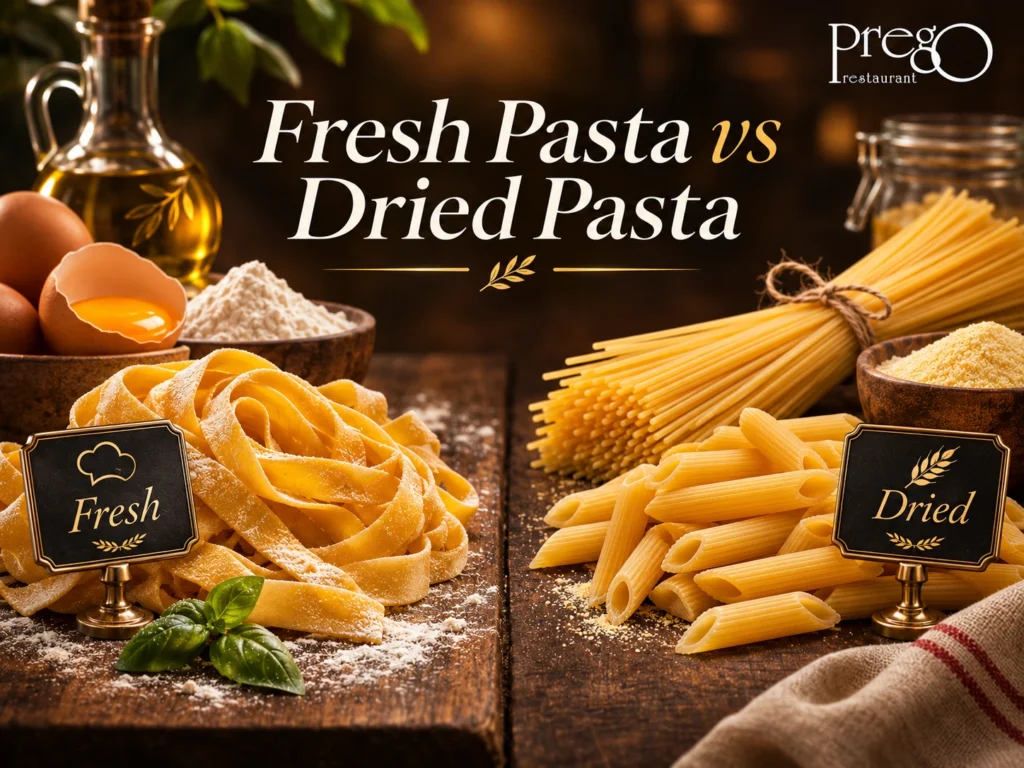

Plenty of people assume fresh pasta is the real thing and dried pasta is the compromise. In an Italian kitchen, they’re treated as two different ingredients with different jobs.
This guide to fresh pasta vs dried pasta covers how they differ, which sauces suit each, and when it makes sense to use one over the other. It also uses three dishes from Prego in Floreat to show how those choices look on a plate.
What Is the Difference Between Fresh and Dried Pasta?
Fresh pasta is usually made from soft wheat flour and egg, cut or filled while the dough is soft, and cooked soon after it’s made.
Dried pasta is usually made from durum wheat semolina and water, shaped through a die and dried so it keeps for months. Fresh is tender and quick to cook; dried is firm and shelf-stable.
Fresh Pasta Vs Dried Pasta At A Glance
| Feature | Fresh pasta | Dried pasta |
| Usual ingredients | Soft wheat flour (often 00) and egg; some is egg-free | Durum wheat semolina and water |
| Texture | Soft and tender | Firm, with an al dente bite |
| Cook time | A few minutes | Often around ten minutes; check the packet |
| Shelf life | Short; follow the use-by date | Months in the pantry; follow the best-before date |
| Sauces that suit it | Butter, cream and ragù | Olive oil, tomato and chunky sauces |
| Typical dishes | Tortellini, ravioli, pappardelle with ragù | Spaghetti with tomato, pasta bakes |
Most of the gap comes down to water. In Italy, Presidential Decree 187/2001 sets the benchmark: dried semolina pasta can hold no more than 12.5 per cent moisture, while prepackaged fresh pasta has to keep at least 24 per cent. That extra water is why fresh pasta is soft, cooks quickly and keeps for less time.
Ingredients: 00 Flour and Egg vs Semolina and Water
The classic fresh pasta dough pairs soft wheat flour with egg. The flour is often 00, a finely milled grade that Italian law defines with a low ash limit. The egg adds richness and colour, and it makes the dough tender and easy to roll thin.
Dried pasta is a different recipe. Under the same Italian law, dried pasta sold as pasta di semola di grano duro is made only from durum wheat semolina and water, and the rules set a higher minimum protein level for semolina than for 00 flour. Durum is a harder wheat, which helps explain why dried pasta holds a firm bite through boiling.
None of this is a strict rule. Egg pasta is a cornerstone of cooking in Emilia-Romagna in the north, while pasta made from semolina and water is more typical further south.
Plenty of fresh pasta has no egg at all, and dried egg pasta exists too: Italian law defines it as semolina with at least 200 grams of egg per kilogram. Prego’s vegan degustation, for instance, lists a house-made spaghetti with no animal products, a reminder that pasta made in-house doesn’t have to contain egg.
Texture and Cook Time
Fresh pasta is soft and tender, with very little resistance. It cooks in a few minutes, and it needs watching because it goes from ready to overdone quickly.
Dried pasta is firmer and takes noticeably longer, around ten minutes for many common shapes, with the packet giving the exact time.
That firm centre is what Italians call al dente: cooked through, but with some bite left. Fresh pasta can have some bite too, but it starts out softer. It matters for the sauce.
A firm shape can sit in a hot, chunky sauce without going soft, while a tender fresh ribbon wants a sauce that coats it gently. Dried pasta is also pushed through a die before it dries, and a rougher surface, which some producers aim for with bronze dies, gives sauce something to cling to.
Which Sauces Suit Fresh Pasta and Which Suit Dried?
Fresh pasta is soft and absorbent, so it suits smooth, rich sauces that coat it. Dried pasta is firmer and holds its shape, so it can carry sauces with more texture.
Fresh pasta tends to suit:
- Butter-based sauces
- Cream sauces
- Slow-cooked ragù
Dried pasta tends to suit:
- Olive oil and garlic sauces
- Tomato sauces
- Chunky sauces with vegetables, meat or seafood
These are habits more than laws. A tomato-based meat sauce can work on either, and the shape often matters as much as the type.
When Is Dried Pasta the Better Choice?
Dried pasta is the better choice for baked dishes, chunky sauces and anything that needs a firm bite. Its low moisture also means it keeps in the pantry, which makes it the easier option for a weeknight.
- Baked dishes. Dried pasta holds its shape through long oven heat, so tubes and shells are the usual pick for a pasta bake. Lasagne is the common exception, since both fresh and dried sheets are used.
- Chunky sauces. Ridged tubes and shells catch pieces of meat and vegetables instead of letting them slide off.
- Olive oil sauces. With little sauce to lean on, the bite of the pasta itself carries the dish.
When Is Fresh Pasta the Better Choice?
Fresh pasta is the better choice for filled shapes, wide ribbons and delicate sauces. The dough stays soft enough to roll thin, cut or fold, and it cooks in minutes.
- Filled pasta. Dried pasta is shaped first and dried afterwards, so a filled shape such as tortellini or ravioli has to be formed while the dough is still soft. That’s why filled pasta is traditionally fresh.
- Delicate sauces. A butter or cream sauce shows off the pasta underneath, and soft pasta takes it up well.
- Wide ribbons with ragù. Pappardelle and tagliatelle have a broad surface that carries a rich sauce.
How Does the Choice Play Out on Prego’s Menu?
Prego’s à la carte menu labels its pasta as house-made, and you can see the full range of Prego’s house-made pasta across its menus. Three dishes show how the logic above works in practice.
1. House-Made Tortellini
The menu lists house-made tortellini filled with Lebanese zucchini and tiger prawn, served with Western Australian scallops wrapped in pancetta.
Filled pasta is where fresh dough does its job: the sheet has to be soft enough to roll thin, fold and seal around the filling.
2. House-Made Pappardelle
The pappardelle comes with meatballs and cotechino sausage in a tomato sauce, finished with grated parmesan.
That’s the kind of hearty, meat-based sauce wide ribbons suit, because their broad, soft surface gives it plenty to cling to.
3. House-Made Gnocchi
Gnocchi appears two ways: with tomato sauce, buffalo cheese, basil and olives, and as an entrée with vongole, crab meat, chilli and garlic in a rosé sauce. Prego says it makes its gnocchi in-house.
Gnocchi sits outside the fresh-versus-dried question, because potato gnocchi is a dumpling of mostly potato with a little flour rather than a pasta dough. New to it? This guide to house-made gnocchi explains how these potato dumplings differ from pasta.
Is Fresh Pasta Better Than Dried Pasta?
Neither is better overall. Fresh and dried pasta do different jobs, so the better one is whichever matches the shape, the sauce and the way you plan to cook it. A soft fresh ribbon and a firm dried tube are rarely competing for the same plate.
At home, a simple way to decide is to pick the sauce first, then choose the pasta to suit it.
Where to See These Dishes
If you’d like to see how the dishes above are written up, the Prego a la carte menu has the full list, and it’s the place to check what’s being served now. Prego is at 440 Cambridge St, Floreat.
FAQs
Does Fresh Pasta Always Contain Egg?
No. Egg pasta is traditional in parts of northern Italy, but plenty of fresh pasta is just flour and water, and some dried pasta contains egg. To avoid egg or wheat, check the label: Australian rules require both to be declared on packaged food, and sellers of unpackaged food must provide allergen information with the food or on request.
Can You Swap Dried Pasta for Fresh in a Recipe?
Often, for ribbons and tubes, but expect a different result. Dried pasta is firmer, takes longer to cook and suits sauces with more body. It doesn’t work for filled pasta, where the filling is sealed inside soft dough, and fresh pasta can turn soft in a long bake.
Does Fresh Pasta Cook Faster Than Dried Pasta?
Yes. Fresh pasta still holds much of its water, so a few minutes in boiling water is enough. Dried pasta has to take that water back in, which is why many shapes need around ten minutes. Follow the packet for dried pasta and keep an eye on fresh pasta, because it overcooks quickly.